Why business travellers are rethinking how they work in the sky
Turn your business class suite into an office above the clouds.
By Staff Writers, January 29 2026
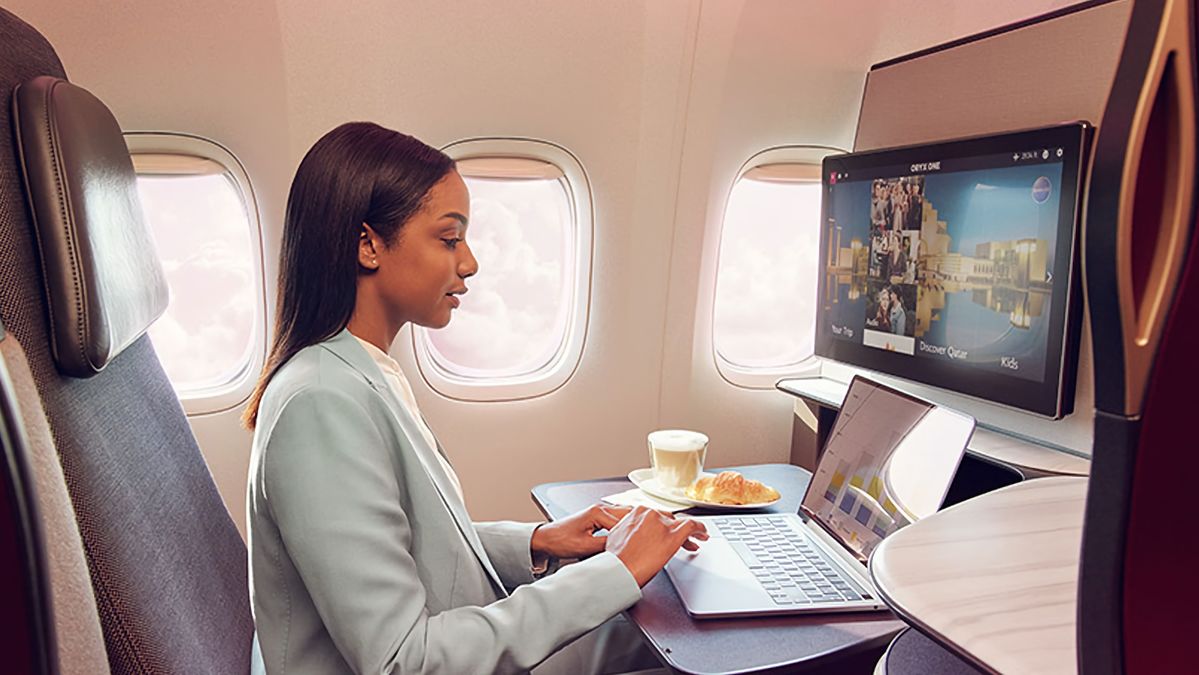
Have you ever been stuck on a long-haul flight with no decent Internet, and felt the frustration of being completely cut off from work for hours on end?
For business travellers, that offline time used to mean falling behind, missing a deadline or having a full inbox of unopened emails on arrival.
But through advances in inflight connectivity, like Starlink, being connected at 35,000 feet is quickly becoming the norm, and expectation.
Travellers can now join meetings, review documents, and stay across projects in real time, even while crossing time zones.
For many, it’s a welcome shift that helps maintain productivity and reduce the post-landing backlog. For others, it signals how work is continuing to blur into every part of life.
Either way, inflight connectivity puts the choice back in the hands of the traveller.
Staying connected above the clouds
This shift comes as global business travel spending continues to gain serious momentum, with data from Flight Centre Travel Group’s Corporate Traveller showing it was on track to reach a staggering AUD$2.327 trillion by the end of 2025.
In 2025, Starlink connected over 21 million passengers across global airlines – and Qatar Airways’ Starlink-connected passengers comprise nearly half of that, enjoying complimentary service on nearly 120 widebody aircraft across long- and ultra-long-haul routes operated by the airline.
That represents almost 60% of Qatar Airways’ widebody fleet, including all Airbus A350s and Boeing 777s, with the Boeing 787 fleet now being upgraded for ultra-high-speed connectivity.
The airline is extending the fastest Wi-Fi in the sky across an increasing number of routes, including flights to the majority of destinations served by Qatar Airways in the Americas and Australia, and on prominent routes in Africa, Asia, Europe, and the Middle East.
A flying office
Inflight Wi-Fi has evolved from a convenience into a critical tool for the modern business traveller.
No longer limited to sending quick emails, today’s connectivity enables full participation in virtual meetings, real-time collaboration on documents, and seamless engagement across multiple communication platforms.
Rather than losing valuable hours in transit, professionals can now stay aligned with project timelines and business objectives mid-flight.
With the rise of fast, stable inflight internet, long-haul journeys have become extensions of the workday, not interruptions to it.
Arriving prepared, not playing catch-up
For executives landing after overnight flights and heading straight into high-stakes meetings, preparation is everything.
Previously, the hours in the air meant limited access to information and little time to get ready, but that’s now changing.
The flight has now become an opportunity to refine presentations, review briefings, or make critical last-minute updates.
Keeping the balance
While inflight connectivity unlocks new levels of flexibility and supports the commonality of remote working these days, it also raises important questions about maintaining balance.
Being able to work mid-air can be a game-changer for productivity, but that doesn’t mean you have to be “on” the entire flight.
This kind of access has benefits for other things outside of work.
Services like Starlink allow travellers to stream their favourite shows, message family and friends, or stay connected to personal life while far from home.