

Flight mode off: I tried mobile roaming on a plane
Mobile roaming is now available on board many popular airlines.
By David Flynn, July 8 2025
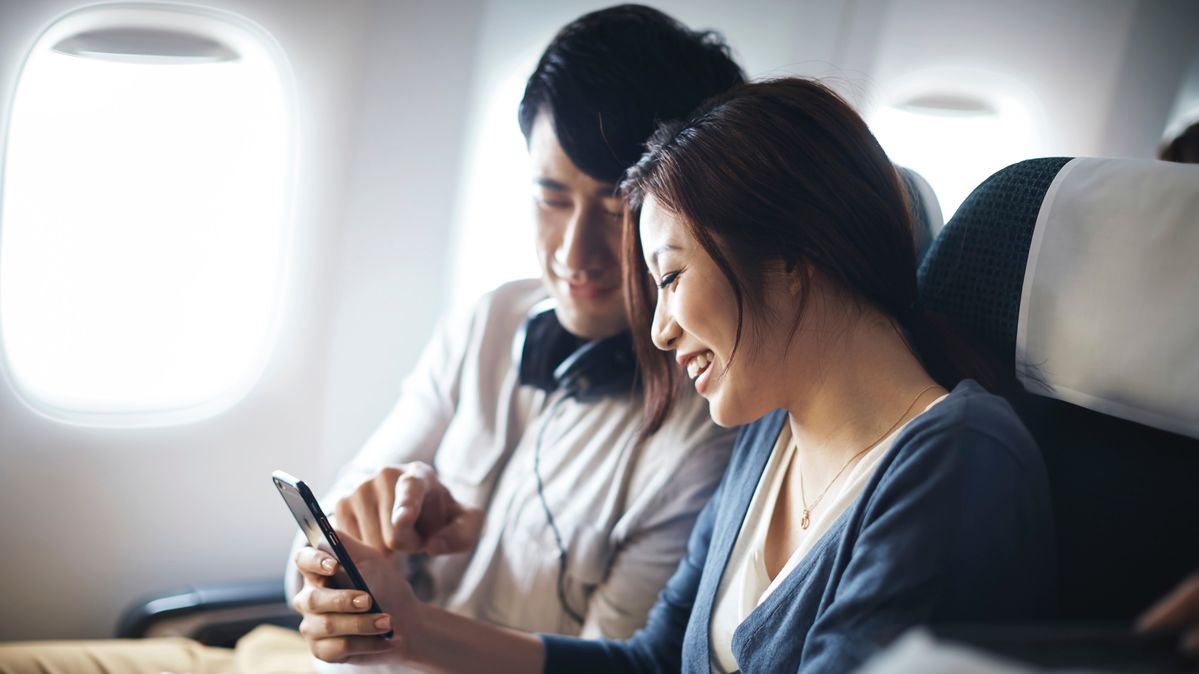
“Please set your mobile phone to Flight Mode,” sounded the obligatory announcement while my plane was still sitting on the runway.
However, once we were airborne, I disabled Flight Mode and went online: not through the plane’s own WiFi system but by connecting my iPhone to a ‘real’ mobile network, despite the fact we were cruising some 35,000 feet above the ground.
In the old days, such impetuous connectivity could have cost me a fortune.
But today, it can cost less than some airlines charge for WiFi – and in the right circumstances, it’s essentially free.
All the same, inflight mobile roaming can also prove quite frustrating. Here’s what you need to know.
Up in the air...
The system I was using was Vodafone $5/day inflight roaming, which is available on almost 20 airlines worldwide.
That roster includes heavy-hitters such as Cathay Pacific, Emirates, Etihad Airways, Lufthansa, Malaysia Airlines, Singapore Airlines, Swiss and Turkish Airlines.
It’s part of the same platform as Vodafone $5/day global roaming, which has long been popular with international travellers who need to remain contactable on their regular mobile number.
Vodafone’s inflight roaming taps into the satellite-powered AeroMobile 3G mobile network.
After disabling flight mode, I just set my iPhone’s network carrier selection to AeroMobile and I’m online for everything from messaging and email to Web browsing, although only at relatively modest 3G speeds.
In several cases, Vodafone’s $5/day in-flight roaming is substantially cheaper than the airline’s Internet plans.
For example, Etihad charges between US$10 and US$25 to remain connected throughout your flight (the exact rate depends on the length of the flight).
On Cathay Pacific the equivalent cost is US$13-$20 (although it’s free in business class and for Cathay Diamond frequent flyers); on Lufthansa it’s a whopping €15-€25.
$5/day roaming
Vodafone’s $5 airline roaming is available to and aimed at Vodafone subscribers who already use the carrier’s standard $5/day global roaming.
And here’s the big advantage: there’s no additional cost on top of any active $5/day global roaming period.
If you activate Vodafone’s $5 inflight roaming and within 24 hours you land in a country covered by $5 global roaming, there’s no extra roaming charge on the ground for the remainder of that time.
For example, if you catch a morning flight from Sydney on Cathay Pacific, Malaysia Airlines or Singapore Airlines, that same $5 you’ve paid for inflight roaming will also cover you in Hong Kong, Malaysia or Singapore for the rest of the day.
The same applies if you’re on $5/day roaming in a country such as Thailand, then hop onto a short Cathay Pacific or Singapore Airlines flight to Hong Kong or Singapore.
That single $5 charge will cover you at the start of your day in Bangkok, during your flight and once you land in Hong Kong or Singapore.
So in those circumstances, you’re not paying a cent more for inflight roaming – it’s essentially free.
How fast is Vodafone inflight roaming?
That said, there are two downsides to Vodafone inflight roaming which can make for a frustrating experience.
First up, speed: the AeroMobile service used by Vodafone is effectively 3G, and on my recent flights around Asia it’s averaged 2-3Mbps.
While that’s usable, it falls short of the 5-10Mbps that many airlines now deliver through WiFi and faster satellite networks.
The other catch: the Vodafone AeroMobile service has been frustratingly unreliable on every single one of my flights.
One minute I’m online, mid-chat on a messaging service or waiting for Web pages to load or emails to arrive in my inbox; and then suddenly I’m offline.
This can and does happen multiple times across the course of a flight, even on a ‘straight-up’ route from Sydney into Asia.
Airline WiFi can also be prone to dropouts, of course, but in my experience inflight WiFi has greater overall consistency and reliability than inflight roaming.
Free WiFi on the rise
Of course, an increasing number of airlines are moving towards free WiFi.
Emirates, Malaysia Airlines and Singapore Airlines now make inflight Internet free for all passengers (although sometimes you’ll need to be a member of the airline’s frequent flyer program).
On Cathay Pacific, inflight WiFi is already free in first class, business class and for Cathay Diamond frequent flyers anywhere in the cabin.
Likewise, Etihad Airways gifts complimentary WiFi in first class and to Etihad Guest Platinum members.
And if simple text-based messaging and chat is all you need, that’s often free to all passengers, even in economy.
So it pays to check the WiFi entitlements with your airline – based on class of travel and frequent flyer status – before firing up Vodafone inflight roaming.
Stay informed: Click here to sign up to the free Executive Traveller newsletter

QFP
22 Jan 2013
Total posts 99
What’s VA1 offering in regards to wifi? Still free for platinum and business?
14 Aug 2019
Total posts 5
Mobile phone should be banned being on - recent flight my family who were on a international flight had to listen to some Yank and his wife waffling on whats app with his grandchildren for over 30 minutes - flight attended told turn off they took no notice!
One World
31 Mar 2020
Total posts 23
Oh, i'd forgotten about that, i've recently moved to the suburbs where i take the metro into town, there is always some motormouth clown that won't shut up, or the senior citizen that has just discovered mobile phones and screams loudly so the other people can hear them, oh, ok, the solution is maybe noise cancelling headphones, that might work.
23 Feb 2017
Total posts 26
Please kill me now Jwaussie48 and put me in a soundproof coffin. Travelling by train has become unbearable because of this. RC
Hi Guest, join in the discussion on Flight mode off: I tried mobile roaming on a plane